
From the dawn of time, mankind has been climbing all sorts of things: trees, the food chain, the corporate ladder, and ROCKS. Rock climbing has recently boomed due to its popularity in the competitive scene, particularly as an addition to the 2020 Tokyo Olympics.
What is rock climbing?
In simpler terms, it is the sport of problem-solving, where you find the most efficient way to ascend a rock using various techniques that combine strength, flexibility and stamina — all avoiding a fall. In this article, we’ll explore how we got into climbing (or perhaps how we fell into it?), and discuss why climbing is beneficial both cognitively and as a long-term sport that people of all ages can enjoy.
Raine’s story
After my family relocated to Danao City in the Philippines, I developed a love for climbing from around ages 4 to 6. I would climb trees, shelves, or anything else I could grip. This early fascination, coupled with boundless energy, led me to be scouted by Jun Vidal, who trained me in rock climbing. I eventually represented Cebu International School in competitions both locally and nationally. Here are a few images from those days, posted on my Instagram:
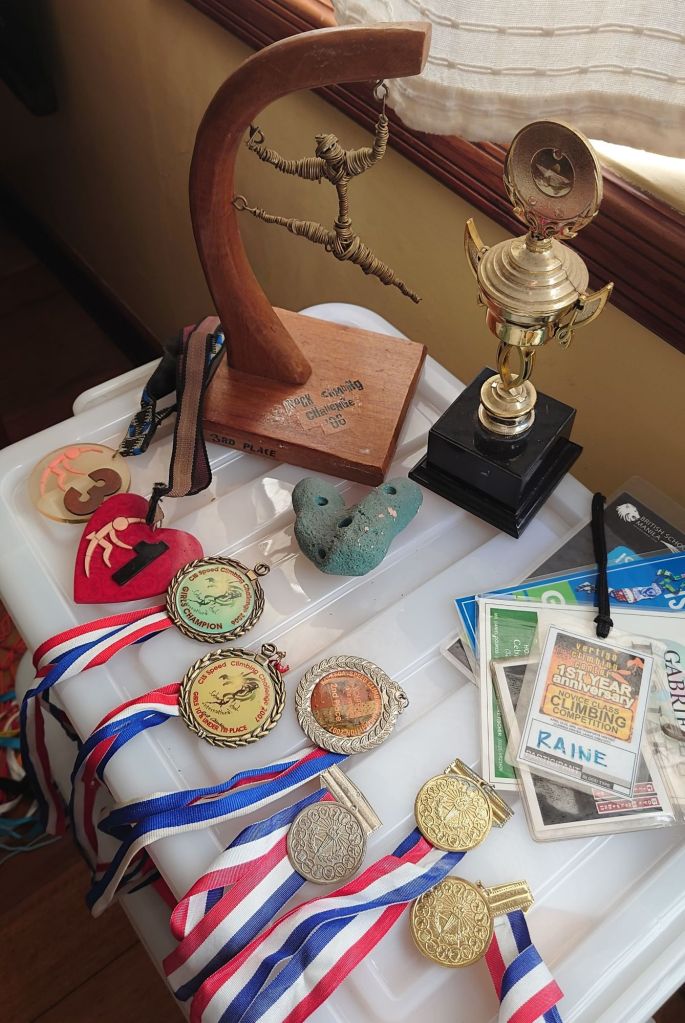
I was only 7 years old when I entered my first Speed Climbing competition. The other kids were mostly boys—much taller, tougher, or older than me. Despite being a skinny kid, I competed for seven years. I still vividly remember this first competition, where I earned third place as a beginner. The medal I earned from training every day—building muscle, improving my grip, speed, and technique—was incredibly rewarding. I promised myself I’d take first place next time, and I did, many times over. My success in climbing earned me recognition at school and inspired other girls to join the rock climbing club and team.
However, puberty took its toll, and by the time I was 14, I began exploring other sports like soccer, volleyball, and basketball. I competed fiercely, won awards, and even earned the title of MVP. But the physical demands and injuries from these contact sports, including several ligament tears, led me to take up Olympic weightlifting at 18 as a form of rehabilitation and eventually starting my diet and fitness coaching business at 19.
It wasn’t until March 2022 (around 25 years old), when I returned to the Philippines after living in Japan, that I reconnected with Kikuchi, who reignited my passion for climbing. This time, I delved into outdoor lead climbing. Kikuchi broadened my horizons in the sport, and I’m forever grateful for maintaining a physically active lifestyle since childhood. That foundation (especially in lifting weights) allowed me to enjoy various activities and transfer skills, even with my past injuries.
When I relocated to Adelaide in December 2022, I joined the UniSA Climbing Club, where I now hold a secretarial position on the executive committee. I continue to encourage others to climb and share the joy of this incredible sport. I also got involved in route-setting and helped Urban Climb hold private tours when their Hindley Street Adelaide branch was under construction before opening in September of this year.
Last year, I competed in two bouldering competitions at Beyond Bouldering’s Clovelly Park gym, and one top-rope sport climbing competition at the Lead Titles of Vertical Reality Climbing (VRC) Gym.
A funny story: for the VRC Lead Title, I cut my right index finger in the kitchen just a week before the competition. Despite the injury, I still competed and came in first place with the fastest time for two of the four rounds! Here’s the image to prove it:
Climbing is like dancing in the sky. You move your entire being to ascend, feeling as if you’re floating like an angel. Break barriers and trust me—you’ll soar to new heights and take on life with a renewed zest.
Kikuchi’s story
As mentioned, I’m partly to blame for Raine getting into climbing, but as for me? It’s a rather intricate process of trial and error in search of the sport that truly fits me.
I once lived on the largest island of Indonesia, where I was first introduced at the young age of 10 or 11. I was in a small international school that was big on outdoor activities. At the time, I was too young to understand what climbing was, and I remembered not liking the grueling process of scaling just 10 meters. But that feeling quickly became a faint, distant memory.
Fast forward to 2015 – 2016, when I grew tired of swimming because it became monotonous and overly competitive. However, I developed a fascination for parkour and would often try to wall run a 3-meter wall. The passion was strong, but the community and parkour scene was small, and I couldn’t practice it without breaking the law.
Looking into an alternative, I remembered rock climbing. It seemed similar to parkour in the sense of going from point A to point B, as efficiently as possible—climbing walls, essentially.
I googled rock climbing and discovered a number of gyms scattered around Tokyo, where I was living at the time. Despite there being on gym just five minutes from my residence, I chose to travel an hour away to a B-Pump gym in Yokohama.
Climbing is addicting. Conquering the grades and fighting hard to finish routes quickly bececame a weekly hobby. This fiery passion followed me to the Philippines, where I fell in love with the limestone (or rather, developed a lust for lime).
I began training to get stronger so that I could defy gravity and climb vertically. Along the way, I met people who helped me to become a better person as well. The climbing community here is small, but it’s made up of a dedicated group of individuals who share the love for the sport. I’ve been able to pass that passion on to Raine.
Thank you for reading my “TedTalk”, and hopefully these fives reasons convince you to get into climbing as well!
It’s fun and challenging!
Climbing is a blend of movement and problem-solving. When you start, you’ll discover that the easier grades focus on technique, where even a slight change in footwork can mean successfully completing a boulder problem. It’s also a social sport; 90% of the time, you will chilld and relax with friends, while the 10% of the time is climbing. Striving to “send” a project together, supporting each other even as you comically fall flat on your back—repeatedly!
The skill ceiling in climbing is very high, making it tough to become a well-rounded climber. With so much to learn, your lifestyle will shift to align with your climbing goals. Dedication to the sport is challenging, requiring both physical strength and mental resilience to overcome fear. It’s fun precisely because it’s challenging, and you won’t become a better climber on your own. If you find the right people to climb with, you’ll grow together as climbers.
It’s long term
Climbing is a lifelong, never-ending journey with no age limit. Older climbers benefit from the sport because their connective tissues, especially tendons in the fingers, take time to strengthen. The longer they practice, the stronger their finger strength becomes (Li et al., 2018).
Climbers who start young adapt quickly and tend to be the strongest, with top athletes typically being young adults (ages 18-25). One example is the recent 2024 Paris Olympics Gold Medalist, Toby Roberts, who is only 19-years old. These young climbers retain their strength and technique well into adulthood. The nature of climbing has the power to change you forever, if you commit.
The reverse is also possible: Akira Waku, a Japanese climber, started at 35, and at 48, he sent his second V16 (a top-tier climbing grade from V0 to V17). His success was likely the result of hard training, proper nutrition, and making climbing a lifestyle.
You can travel the world
If you love traveling with a touch of adventure, climbing is an ideal sport, as it’s practiced worldwide. Eventually, you’ll find yourself wanting to climb in different locations and environments, immersing yourself in nature and creating unforgettable experiences, and making new friends along the way from these trips.
It’s good for your brain, and health
Climbing offers numerous benefits, both mentally and physically:
- Problem-solving skills
- Focus and concentration
- Stress reduction
- Confidence
- Mental resilience
- Coordination and spatial awareness
- Social interaction
- Cognitive flexibility and creativity
How can you get into climbing now?
Climbing is about exploration and adventure, searching for legendary rocks to scale. The sport is growing globally, especially since it was added to the 2020 Tokyo Olympics, and the Oscar-winning documentary Free Solo helped raise awareness. With more countries supporting climbing, it’s easier than ever to get started. If you search for rock climbing, you’ll likely find a gym nearby or an outdoor crag to explore.
Going to a climbing gym is one of the easiest ways to begin. Be sure to bring friends or mingle with fellow climbers at the gym. The climbing community is full of like-minded people who are usually eager to help others on their journey to becoming stronger climbers. They’ve all been there and continue to support one another.
If there are beginner clinics offering outdoor guiding, be sure to take part—they’re a guaranteed, eye-opening experience. You’ll realize that the gym is just a simulation; the real outdoor climbing experience is magnificent, daunting, and exciting all at once. This, in my opinion, is the true way to get into climbing, driven by passion, determination, and a vision to improve every day.
References:
Li, L., Ru, A., Liao, T., Zou, S., Niu, X. H., & Wang, Y. T. (2018, October). Effects of rock climbing exercise on physical fitness among college students: A review article and Meta-analysis. Iranian journal of public health. https://www.ncbi.nlm.nih.gov/pmc/articles/PMC6277736/

This article was written by John Kikuchi and editted by Raine Baljak.
 Artist & Academic